Google Finally Shows How Often AI Answers Cite You. Here’s What We Saw Across Four Sites.
Search Console now reports how often your pages appear inside Google’s AI answers. We looked at the first full month of it across four very different client sites, and the same pattern showed up on every one of them.
For the last couple of years, the honest answer to “are we showing up in AI results?” has been “let’s search and see.” Somebody types a question into Google, spots the site in an AI Overview, takes a screenshot, and that’s the evidence. It’s anecdote dressed up as reporting.
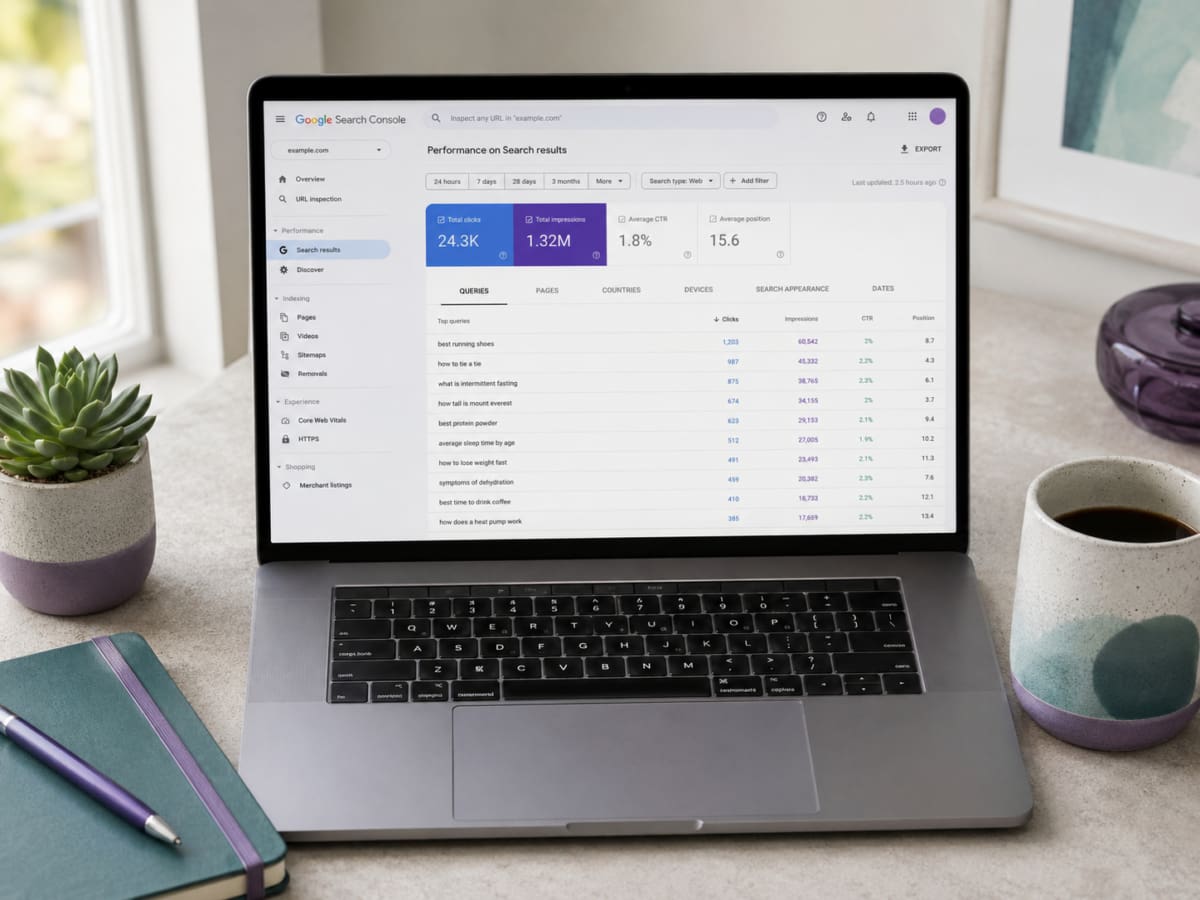
That changed this summer. Google announced a generative AI performance report for Search Console in June and finished rolling it out to every site on August 31. It counts how often your pages are shown inside AI Overviews and AI Mode, broken down by page, country, device and date. August was the first month we could report on it for every client, so we did.
Four sites, one month
These four sites have almost nothing in common, which is what makes the comparison useful. A medical aesthetics practice, a freight training company, a trade show booth manufacturer, and a local computer repair shop. Here’s how many times each one appeared inside Google’s AI answers in August.
198 pages cited
68 pages cited
56 pages cited
15 pages cited
FACE/FIT, the aesthetics practice, appeared in AI answers 3,472 times against roughly 36,900 total search impressions. FreightPath appeared 3,648 times against 38,286. On both sites, that’s about one in every ten search appearances happening inside an AI answer rather than a normal results listing.
Exhibit Boss was the biggest by far at 13,638 appearances. Ohio PC Solutions, the repair shop, was the smallest at 227, which is exactly what you’d expect from a local business with a small site. Its most interesting number comes later.
Explanations get cited. Listings don’t.
This was the pattern that showed up everywhere. The AI answers overwhelmingly draw on pages that explain something, and almost never on pages that just list something for sale.
FreightPath has 86 individual course pages, fifteen category pages and a catalog. Between them they produced 93 AI appearances. The blog produced 3,348. A course page is a product listing, and no amount of tidying turns a listing into an answer.
Exhibit Boss showed the same thing from a different angle. The pages being cited most were the ones we’d rewritten with real specifications and plain explanations: the modular booth category, the pop-up category, the retractable banner guide. Rewriting those pages for people turned out to be the same work that gets them quoted by machines.
Zero clicks doesn’t always mean zero value
Here’s where the new report changes how older numbers should be read. FACE/FIT has an article on perimenopause and skin that collected 581 impressions in August at an average position of 9.5, and zero clicks. A year ago we’d have called that a page that isn’t working.
The AI report shows the same article appeared in 352 AI answers that month. It isn’t being visited. It’s being quoted. That’s a different job, and a legitimate one.
We saw a related pattern on both FACE/FIT and FreightPath: searches where the site sits at or near position one and still gets no clicks. Ordinary blue links at the top of the page don’t behave like that. The most likely explanation is that those impressions are citations inside AI answers. We’d call that a strong inference rather than something Google confirms, but it’s consistent across dozens of searches.
The visitors who do click through are the good ones
The traffic that AI assistants send is still small. But on the two sites where we measured it closely, those visitors behaved better than anyone else.
On Exhibit Boss, 62 visits came from AI assistants in August, mostly ChatGPT, and they stayed an average of 87 seconds, longer than any other group on the site. Those visits produced three leads. On FACE/FIT, referrals from ChatGPT more than doubled, from 9 in July to 20 in August, with a 95 percent engagement rate and about two minutes of attention each. That makes sense: someone who clicks through from an AI answer has usually been told you’re worth looking at before they arrive.
New pages can get picked up fast
Ohio PC Solutions had the smallest numbers, and the most encouraging detail. The homepage took most of the shop’s 227 AI appearances, as you’d expect. Second place went to a guide comparing surge protectors and power strips, with 24 appearances, from a page that was barely two weeks old.
One month is a reading, not a trend. But it suggests that a plainly written, genuinely useful page doesn’t need years of history before these systems start drawing on it.
What to check in your own Search Console
If you have access to your site’s Search Console, you can look at this yourself in a few minutes.
In This Post
Related Reading